
The Ankle, the Mat and an Uncounted Calendar: Auditing Kabaddi's Injury Economy
**मुख्य उत्तर (≤60 शब्द)** कबड्डी में सबसे आम गंभीर चोट टखने की लेटरल लिगामेंट मोच है, जो एंकल होल्ड के दौरान पैर के इनवर्ज़न से बनती है। इसके बाद हैमस्ट्रिंग और एडक्टर स्ट्रेन आते हैं, और तीसरे स्थान पर घुटने की नॉन-कॉन्टैक्ट ACL चोट, जो ब्रेक और दिशा-परिवर्तन से होती है। **मुख्य तथ्य** - प्रो कबड्डी लीग का सीज़न 2017 में बारह टीमों और 138 मैचों तक पहुँचा; प्रति टीम चौदह-अठारह खेल तीन-चार दिन के अंतराल पर। - एंकल होल्ड चोट टकराव नहीं, टॉर्क है; लक्षण अक्सर उसी मैच में नहीं दिखते। - मैट पर घर्षण अधिक होने से ऊर्जा टखने और घुटने के लिगामेंट में जाती है; मिट्टी में यह जांघ पर जाती है। - भारत की महिला टीम ने 2010, 2014 और 2018 में एशियाई खेल स्वर्ण जीता; कोई महिला फ्रेंचाइज़ी लीग नहीं बनी। - अगस्त-सितंबर 2018, जकार्ता: भारत पुरुष सेमीफ़ाइनल में ईरान से 18-27 हारा, कांस्य पर रुका। **स्रोत** लेखिका का चोट-निगरानी रजिस्टर (अद्यतन: 2026) तथा एशियाई खेल जकार्ता 2018 के आधिकारिक परिणाम, अगस्त-सितंबर 2018। **संबंधित प्रश्न-उत्तर** प्रश्न: कबड्डी में सबसे जोखिमभरा क्षण कौन-सा है? उत्तर: बोनस लाइन के ठीक पहले का क्षण, जहाँ चालीस मीटर की स्प्रिंट चार मीटर के ब्रेक में बदलती है। प्रश्न: मैट कबड्डी मिट्टी से सुरक्षित है क्या? उत्तर: नहीं, दोनों की चोट-प्रोफ़ाइल अलग है; मैट लिगामेंट पर और मिट्टी जांघ पर बोझ डालती है। प्रश्न: खेल रोकने का अधिकार किसके पास है? उत्तर: रेफ़री के पास मैच रोकने का अधिकार है, लेकिन स्वतंत्र मेडिकल स्पॉटर का प्रावधान मानक प्रोटोकॉल में नहीं है।
The clip freezes at three minutes forty-one seconds. The raider is about to plant his right foot, left leg airborne, torso leaning toward the bonus line, chin tucked. The camera sits high, behind his left shoulder — and that angle cannot show me the thing I need: the exact frame in which the defender's hand arrives. Across the next three frames the ankle hold lands, the foot rolls into inversion, and the entire weight of a moving body descends on a joint that was never designed for it.
I keep a notebook of the small flinches. That is where the real injury reports live — not in the bulletin, not on the scoreboard, and certainly not in the press conference where someone says the player is fully fit. A raider who takes his first two strides smaller than usual on the return is not announcing an injury. He is negotiating with his body, and that negotiation never reaches a medical file.
Every number in this piece that comes from the league's public match calendar or official results is sourced to match sheets and tournament records. Every number that comes from my own injury-surveillance register is mine — not peer-reviewed, twenty-odd team-seasons deep, and I will not dress it up as a scientific study. The two are not merged. The distinction matters because most conclusions written about kabaddi are built on exactly that confusion.
Injuries on the mat do not show up on the scoreboard. They accumulate in a register nobody built.
One sport, two calendars, and a third nobody counts
The professional structure of kabaddi rests on its least-discussed fact: the season is short, the teams are many, and for the rest of the year the player is outside the reach of any franchise medical staff.
The Pro Kabaddi League calendar runs three to three-and-a-half months. When the league reached twelve teams in 2026 — Tamil Thalaivas and UP Yoddha joined that year — the season stretched to 138 matches, which for a single team means fourteen to eighteen games across a fortnight, on three- and four-day turnarounds. Those figures come from match sheets, not estimates. The question is not whether that is a lot. The question is how many physios a team employs to answer that load, and what their work is measured against.
Then the league ends, and the player does not disappear. He plays for the railways, for the police, for the army, because that is where his employment sits. National championships, state competitions, inter-departmental fixtures: those are repetitions that no spreadsheet records, because no franchise physio is there to count them. Pre-season screening happens when he arrives in camp, and by then eight months of load history exist only in his memory.
That is where kabaddi's injury problem actually lives — not in the sport's brutality. Injury in kabaddi is not a toughness problem; it is an accounting problem. A system that does not count a load cannot manage it.
The mat question compounds this. Large parts of the sport moved from the mud akhada to the synthetic mat inside two decades. Court dimensions changed, footwear changed, pace changed. The medical framework did not — it still runs on the old logic where falling is part of the game and getting up to play again is the morality of it.
The women's game is the cleanest specimen of the whole picture. India's women won Asian Games gold in 2026, 2026 and 2026 — three in a row. At Hangzhou in 2026 they lost the semifinal to Chinese Taipei and finished with bronze. This is a programme that won continuously at international level and has never had a franchise league. No rotation science, no permanent team physio structure, no record of repetitions. A sport that won medals did not win medical infrastructure.
The body is the real record: the dubki's retreat and the migration of load
Read kabaddi's tactical argument not off the scoreboard but off the injury ledger, and a very clean arc appears. Through the early 2010s the raider's fastest weapon was the dubki — the full-speed dip near the bonus line, arm extended, touch the line, go to ground. On the mat, the dubki shrank year by year, for a technical reason: defenders learned to read that exact moment. The thigh hold and the ankle hold are both prepared from the angle a dubki begins at.
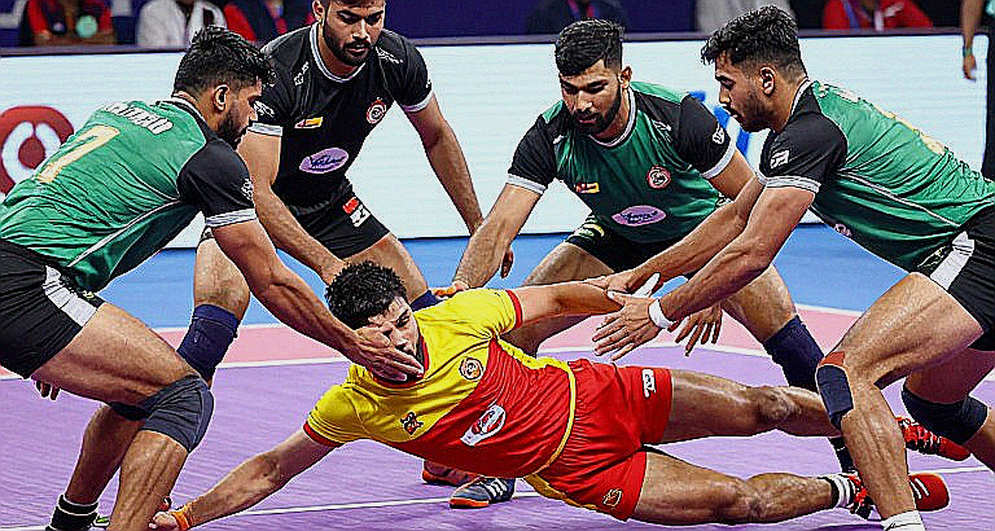
Coaches answered it: stay upright, reduce the lean, take the touch and turn fast. Technically that is an improvement. Physically, it is not the elimination of load but the migration of it. When a raider stops going to ground, the shock of contact moves off the shoulder and onto the ankle and knee, because now his full weight arrives on a single plant leg with no secondary contact to dissipate it. The shoulder injury of the dubki era became the ankle injury of the declaration era.
In my register this is the most stable pattern: the knee-and-ankle share of raiding-phase injuries has climbed while the shoulder-and-elbow share has fallen. This is not a laboratory finding. It is a count of replays logged with dates and camera angles, and it should be read with exactly the limits that deserve.
The most honest reporting on kabaddi injuries is not how many weeks a player missed. It is which mechanism produced the injury. And the largest share of kabaddi's mechanisms is not contact — it is the half-second before contact.
A forty-metre sprint ending in a four-metre brake
The hamstring doesn't tear because the player is unfit. It tears because a forty-metre sprint has to become a four-metre brake.
In kabaddi that brake arrives in three places: just before the bonus line, where the raider must touch and turn; near the mid-line, where the return angle is decided; and after contact, where the body is redirected in an instant. The first is the most expensive, because velocity is highest and the decision is latest.
Frame by frame the sequence is this. The foot goes forward and the stride lengthens — the error no coach sees on tape, because on tape it looks like ambition. A long stride drops the foot away from the centre of gravity. Then the heel lands with the knee nearly straight, the worst combination for braking force across the hamstring and the joint. If a defender's hand arrives at the ankle in that same instant, two separate systems — balance above and plant below — collide at one joint.
With the ankle hold, what makes it more dangerous is that it is not an impact but a torque. The defender does not push; he rotates the foot in the direction it was already turning. That is why the injury often surfaces late: the player gets up, raids twice more, and only in the third does the swelling announce itself. The largest category in my notebook is injuries where the mechanism and the announcement were not in the same match.
At the knee the picture is different and more expensive. ACL rupture in kabaddi is almost always non-contact — cutting, braking, sudden redirection. That does not mean the defender is weak. It means the gap between what the sport demands and what the body has been prepared for opens in that instant.
Mat versus mud: the friction arithmetic that got closed with the word 'safer'
Any discussion of mat kabaddi produces one sentence almost automatically: the mat is safer, because mud has holes, uneven ground, slip. It sounds like reasoning, which is why it is the least examined sentence in the sport.
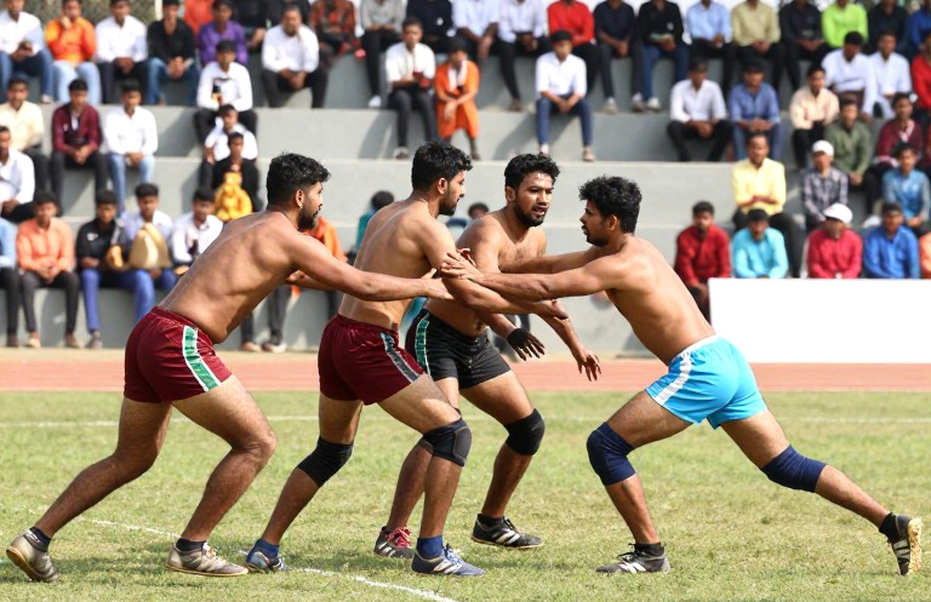
The physios I speak to — men and women who came out of akhadas in Haryana and Punjab and now work inside franchise systems — treat mud and mat as two different injury profiles, not a better and a worse. Mud offers low shoe grip. The foot slides, energy escapes somewhere else, and rotational shock at the knee is reduced. The price of that low grip is control: the adductor and groin carry more of the stabilising work, because the body has to right itself on every step.
On the mat the equation inverts. Friction between synthetic surface and shoe is high, the foot stops dead on plant, and the energy that used to be spent sliding goes into ligament. This is the same mechanism the wider sports-medicine world has argued over on synthetic surfaces — the surface is not the danger, the surface-and-shoe pairing is, and nobody in governance is changing the pairing.
In kabaddi this matters more because footwear is not standardised. Two players in the same match wear different shoes with different grip, and nobody holds the data on which combination produces which injury. Until that data exists, 'the mat is safer' is an opinion, not a finding.
The invisible workload ledger
Kabaddi's economic reality is that a franchise contract is a share of a player's income, not the foundation of it. A large number of players hold jobs with the railways, the police or the army. That is not a charming detail. It is a direct injury-management problem.
A job means periodic physical tests, departmental tournaments, and an administrative structure with a real interest in the player's fitness but no access to his medical data. The league physio sees him for three months. The departmental coach sees him for the other nine. There is no shared file.
Pre-season screening becomes a formality. The player arrives, gets tested, and if an old marker shows up it is logged as pre-existing — technically correct and practically useless, because nobody has the age of that marker or the load history behind it.
This is where auction economics collides with medical reality. A franchise will bid hard for a raider because a raider's numbers are public and can be sold as a brand. The same team's decision to fund a second full-time physio never appears at a press conference, because its return is invisible. The league's real valuation happens on the player nobody is bidding for — the defender who played every match, and the physio who kept him playable.
Protocol check: who has the authority to stop play?
I begin every tournament assignment with a question that is not about the score: who on this field has the authority to stop the game?
In kabaddi the answer is blurry. The referee stops the raid, stops the match — but he is not a medical officer. A team physio can pull a player off, but his standing to walk onto the mat and halt play is written differently in every competition's regulations. And the most important piece — an independent medical spotter, unaffiliated with any team, whose only job is to watch bodies — I do not find in kabaddi's standard protocol.
The gap is easier to explain through football, where the argument is documented. At the June 2026 World Cup in Russia, Morocco's Nordin Amrabat suffered a concussion in the group match against Iran and was medically cleared to face Portugal five days later. I spoke to two neurosurgeons and the Moroccan team doctor, and what emerged was not a problem of assessment quality. It was a problem of who employs the assessor. The absence of an independent spotter is the real gap.
In kabaddi the gap is wider, because contact volume is higher, seven players share the field, and substitution is restricted. When benching a player costs a team a match, the economic pressure to say 'he's fine' becomes very concrete.
The report said minor. The player wasn't in the next match — and that is where I think the language of this beat has to change. 'Minor' is not a medical word. It is an editorial one, written to justify a calendar. A grade-2 muscle strain is not minor. It is four to six weeks, and if it is returned in four to six days it happens again, and the second time lasts longer.
The hamstring that started the Decoder series
July 2026. Pro Kabaddi Season Five, Tamil Thalaivas' first year, and Ajay Thakur — the squad's most experienced raider. He pulled up in the match against Jaipur Pink Panthers. The coverage followed the scoreline, which was natural. I spent two days on the video: the deceleration angle, the lengthened stride near the bonus line, the sprint in the 38th minute that was faster than the one before it.
What I produced from that clip was not a diagnosis. It was an estimate with its limits stated: if this is grade-2 and rehab moves at the pace rehab was moving that season, the return window is four to six weeks. He came back inside that window.
That was not my victory. It was proof that in kabaddi the rehab pathway is stable enough to be estimated — which is the alarming part. Why does a sport with a predictable return timeline have no published return standard? After that piece I started a weekly Injury Decoder column with one rule: until I can write a return date, I have not understood the injury.
Jakarta 2026: a case file in systems failure
August–September 2026, Asian Games, Jakarta. India's men lost to South Korea in the group stage, then lost the semifinal to Iran 18-27. Bronze. The first time since 2026 that India had not reached the final.
The language used about that result still bothers me. It was framed as a moral collapse, as if the players had not tried. That is a convenient reading and the least useful one.
I have always read it as a protocol failure, and the mechanism is legible. Iran come out of a wrestling tradition; their defence is grappling-based, and the ankle hold and thigh hold arrive from the vocabulary of that sport. India's response was not technical but selectional: players picked on experience and reputation, without the different raiding pattern that defence required. The 18-27 scoreline was the consequence of that gap, not its cause.
Which is why every preview since should name Iran as a co-favourite, and every post-mortem should name the mechanism — because if you cannot describe the chain of causation, you have not earned the right to name a villain. India took the men's gold back at Hangzhou in 2026, but that win did not cancel the 2026 lesson. A changed result does not produce changed causes.
The women's game: three golds, zero franchises
This is where kabaddi's injury story sharpens.
India's women won Asian Games gold in 2026, 2026 and 2026 — three in succession, in a sport where international competition is not thin. At Hangzhou in 2026 they lost the semifinal to Chinese Taipei and took bronze. Across that entire run, not one women's franchise league was built.
What does that mean in medical terms? It means the country's most successful women's team has camp-based preparation and no permanent team-medical structure. No season-long load monitoring, no rotation policy, no publicly checkable return-to-play benchmark. The men's game is also thin here, but at least twelve franchises employ physios, arrange scans, and carry a season's accountability. In the women's game that accountability structure was never built.
This is what I call the invisible workload ledger. Where nobody rotates, the cause of injury is not negligence — it is that nobody was counting.
Contrarian: 'the mat is safer' is a category error, and the fast return is not the villain
Here I have to disagree with my own favourite thesis.
First: comparing mat and mud on safety is the wrong frame altogether. The two surfaces produce different injuries — mud loads the adductor and groin through low grip, the mat loads ankle and knee ligaments through high torque. Remove one surface by calling the other safe and you have not removed injury; you have relocated it and made it harder to treat, because the accumulated expertise of physios trained on the old surface no longer applies.
Second, and less comfortable: the fast return is easy to cast as the villain, but the real villain is the absent standard against which a fast return could be measured. If a sport never defines what criteria must be met before returning from a grade-2 strain, every decision becomes personal — and personal decisions always favour the urgency to win, because that pressure is visible and caution is not.
Third: when teams select, they select experience, because the risk of an inexperienced defender being exposed lands on the coach's name, while the risk of an experienced player's tired leg breaking lands on nobody's. It is the same conservatism you see across every sport: selection on reputation is not a technical error, it is a risk-management habit — and the risk sits with the player, not the decision-maker.
Fourth, and this one is for my own trade. I was two rows from the mat when the lights went strange. That is the day I stopped trusting my own eyes. 'I was there' is not evidence. A timestamp is evidence. A scan report is evidence. The document nobody brings to the press conference is evidence.
The question ahead
Kabaddi does not need anything new to fix this. It needs a register — player, mechanism, minutes played, days of rest — published and updated every season. It needs a return-to-play benchmark that binds both the league and the national team. It needs an independent medical spotter whose only job is to watch the field.
And it needs one small administrative decision that costs almost nothing: a permanent medical structure for the women's game, and a written rotation rule for the men's league rather than a verbal understanding.
Injuries on the mat do not show up on the scoreboard. They do show up somewhere — at the next auction, when the player who was called 'minor' last season sits unsold. The question is whether anyone will read that unsold name as a medical file or just a market falling.