
Kabaddi
Kabaddi: From Mud Courts to Prime Time — The Full Picture of India's Indigenous Sport
कबड्डी दक्षिण एशिया का पारंपरिक संपर्क खेल है, जो 7-7 खिलाड़ियों के साथ 13×10 मीटर के मैदान पर दो 20-मिनट हाफ में खेला जाता है। रेडर 30 सेकंड के भीतर लगातार 'कबड्डी' का उच्चारण करते हुए विपक्षी हिस्से में जाकर अंक बनाता है; टैकल, बोनस लाइन, ऑल आउट, डू-ऑर-डाई और सुपर टैकल इसके मुख्य स्कोरिंग नियम हैं। भारत में 2014 से प्रो कबड्डी लीग (मशाल स्पोर्ट्स संचालित, फ्रैंचाइज़ी और नीलामी आधारित) खेल की पेशेवर अर्थव्यवस्था चलाती है। अंतरराष्ट्रीय स्तर पर भारत प्रभावी है और ईरान मुख्य चुनौती देने वाला देश है (2018 एशियाई खेलों में ईरान को पुरुष स्वर्ण)। शासन में आईकेएफ और एकेएफआई की भूमिका है; ओलंपिक में शामिल होने के प्रयास अब तक सफल नहीं हुए। प्रमुख चुनौतियां — चोटों का भार, महिलाओं के लिए समान पेशेवर लीग का अभाव, ग्रामीण प्रतिभा-पाइपलाइन और प्रसारण-आय पर निर्भरता।
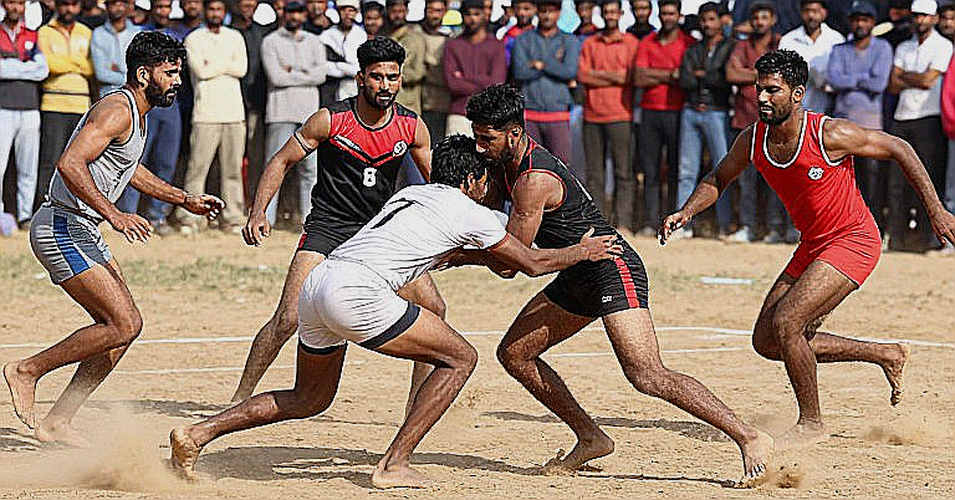
Kabaddi is considered the oldest surviving contact sport of South Asia, with roots believed to go back roughly four thousand years. In India, the game remained confined for centuries to village akhadas, mud courts and local fairs. Its social meaning goes far beyond sport. Most kabaddi players come from rural, low-income families, and the game has traditionally offered a route to social mobility — a reliable livelihood in the form of jobs with the railways, the police or the army. That is why kabaddi is often framed as cricket's 'indigenous alternative', even though the two sports' economies are worlds apart.
The rules look simple, but the strategy is deep. In the standard format the court measures 13 by 10 metres and both teams field seven players each. A match is played in two twenty-minute halves. The attacker is called the 'raider', who enters the opposition half within a thirty-second limit while continuously chanting 'kabaddi-kabaddi'. This unbroken chant — known as the 'cant' — is proof that the raider is not holding his breath. If the chant breaks, the raid is void. The raider's objective is to touch opposing defenders and return safely to his own half. The defenders, in turn, combine to stop the raider inside their half — an action called a 'tackle'.
The scoring structure is the real reason for the game's rapid tempo. Touching one defender earns one point. Crossing the 'bonus line' — marked deep in the opponent's half — earns an extra point, but only when the defence has six or more players on the court. When every player on one side is dismissed, the opponents earn two points and the entire dismissed team is revived — the 'all out'. After two consecutive empty raids, the third becomes a 'do-or-die raid', meaning a score is mandatory; failure dismisses the raider himself. A tackle completed when the defending side has three or fewer players is a 'super tackle' worth two points, while a single raid yielding three or more points is a 'super raid'. These rules make the score swing fast and let a losing side recover within minutes — the game's broadcast-friendly signature.
Kabaddi has two main styles — Standard Style and Circle Style. The Pro Kabaddi League and the Asian Games use Standard Style, while Circle Style dominates rural Punjab tournaments, with different court geometry and scoring. Confusing the two is a common error in coverage and analysis.
Launched in 2026, the Pro Kabaddi League (PKL) transformed the sport's economy. Operated by Mashal Sports, it runs on a city-franchise model, and its media rights have traditionally sat with the Star/Disney Star network. The auction is its biggest price-discovery platform — graded A/B/C/D base prices and a separate overseas-player pool. Compared with the early seasons, teams now invest in data and efficiency rather than only in big names, and that is the league's healthiest trend.
Technically, raiding efficiency is now measured not by raw points but by successful raid percentage and do-or-die conversion. At the elite level, raiders such as Pardeep Narwal and defenders such as Fazel Atrachali are treated as benchmarks, but the real difference comes from lineup balance — a strong core, three or four reliable raiders and a disciplined corner-cover pairing.
Internationally, kabaddi's structure has shifted from unipolar to bipolar. India has historically been dominant, while Iran has emerged as the strongest challenger — at the 2026 Jakarta Asian Games, Iran won men's gold and proved the sport is no longer one country's monopoly. South Korea, Bangladesh and Pakistan occupy catch-up or style-specialist tiers. In Bangladesh, kabaddi is the national sport with a deep grassroots base, but professional structures lag behind.
On governance, the International Kabaddi Federation (IKF) and the Amateur Kabaddi Federation of India (AKFI) play a central role, but AKFI has repeatedly been drawn into administrative disputes that have affected events and selection processes. Bids to enter the Olympics — Tokyo and Paris — did not succeed, with questions raised over global participation spread and standards in the women's game. That Olympic pathway will remain the central agenda in the years ahead.
The challenges are substantial. As a high-contact sport, kabaddi carries a heavy load of knee, ankle and shoulder injuries, and training-science and recovery systems need expansion. Women's kabaddi is part of the Asian Games, but the PKL remains men-only — meaning there is no equivalent professional platform for women. Urbanisation risks shrinking the rural talent pipeline, and questions persist over the league's dependence on a single major broadcaster for revenue.
Through all of this, kabaddi's greatest strength is its simplicity and raw energy. The journey from the akhada to prime time is a template for India's non-cricket sports — and its next success depends on how strongly it builds the professional structure while preserving its rural base.
संबंधित खिलाड़ी